

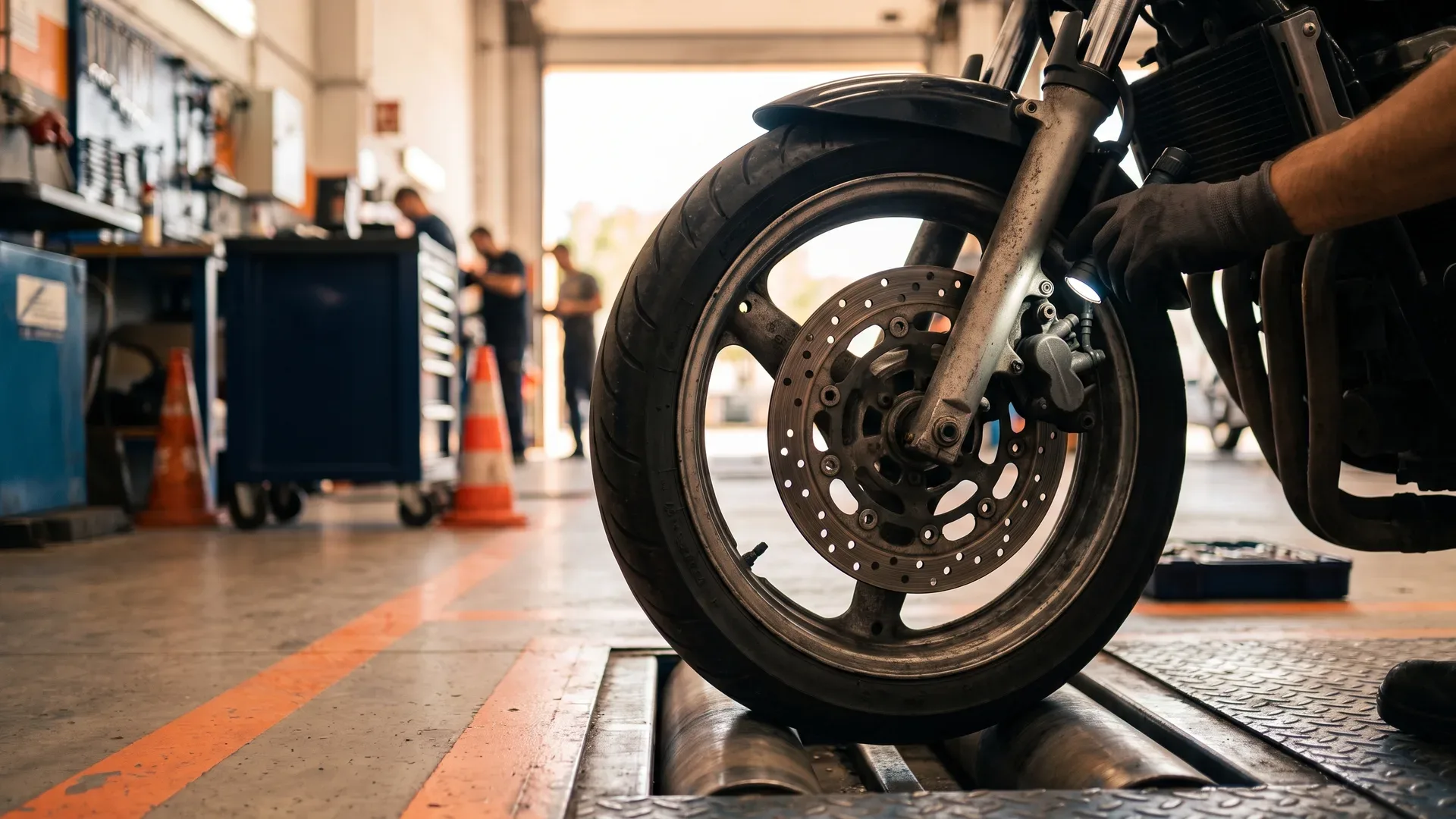
In France, the motorcycle roadworthiness test (contrôle technique, the French equivalent of the MOT) has been mandatory since 15 April 2024 for motorised two-wheelers, three-wheelers and quadricycles. Its date depends on the year of registration: a 2020 or 2021 motorcycle must pass it before 31 December 2026, a 2022 or newer motorcycle within the six months before its 5th anniversary, then every 3 years.
Nobody will send you a notice. The simplest approach is to file the test certificate in WheelTrust, the digital service record that handles a motorcycle exactly like a car. It shows the next test date under your Upcoming due dates, and flags it three months ahead. When you upload the certificate, WheelTrust reads its date, the mileage and the next test date written on it.
When to have your motorcycle tested
The date of first registration is in box B of your French registration certificate (carte grise). It sets your calendar.
First registered before 1 January 2017: first test by 31 December 2024 at the latest, then every 3 years.
First registered from 1 January 2017 to 31 December 2019: first test in 2025, then every 3 years.
First registered from 1 January 2020 to 31 December 2021: first test in 2026, no later than 4 months after the anniversary of first registration, and never after 31 December 2026, then every 3 years.
First registered from 1 January 2022: first test within the 6 months before the 5th anniversary, then every 3 years.
The French Ministry for the Ecological Transition gives a simple example. A motorcycle first registered on 1 June 2022 is tested between 1 December 2026 and 1 June 2027.
If your motorcycle falls into the first two cases and has never been tested, you are already late. Book an appointment straight away. For 2020 and 2021 motorcycles, the end of the year is approaching and centres are filling up: better to book in November than in December.
A pass is valid for 3 years. The deadline for the next test is shown on the sticker attached to the registration certificate.
Vehicles covered, and those exempt
The test covers the whole L category, from L1e to L7e. In practice, that includes:
mopeds, scooters and 50 cc motorcycles limited to 45 km/h;
motorcycles of all engine sizes, 125s included, and motorcycles with a sidecar;
motor tricycles;
quadricycles, meaning quads and microcars.
There are two main exceptions. Enduro and trial motorcycles used for sport are exempt, provided their owner holds an annual sports federation licence. Classic vehicles first registered before 1960 are exempt too. After that date, a classic two-wheeler is still tested, but every 5 years instead of 3.
What the inspector checks: 80 points
The inspector reviews 80 points, grouped by function:
vehicle identification, documents and number plate included;
braking and steering;
visibility, lights and electrical equipment;
axles, wheels, tyres and suspension;
the chassis and its attachments, as well as the horn;
nuisances, meaning pollution and noise level.
Each defect found is classed as minor, major or critical. A minor defect is simply noted. A major defect gives a fail: you have 2 months to repair it and pass the retest. A critical defect is an immediate danger, and the test's validity ends that same day.
Noise is among the nuisances measured. If your motorcycle's exhaust is no longer the original one, check before the appointment that it is approved for your model, and keep the proof.
How much a motorcycle roadworthiness test costs
The price is not regulated. Each centre sets its own and must display it at the entrance. The public website prix.conso.gouv.fr, run by the French consumer protection authority, compares the centres near you.
As a rough guide, the prices declared by centres in early October 2026 give a median of about €70 for a motorcycle, and 8 centres out of 10 charge between €60 and €81. The retest is charged on top.
What you risk without a test
Riding without a valid test exposes you to a fixed fine of €135, which can rise to €750. During a roadside check, the police can also immobilise the motorcycle. They then keep the registration certificate and give you a temporary circulation permit, valid for 7 days, so you can get the test done. Impoundment is also possible.
Selling is the other moment the test catches up with you. In France, a motorcycle over 5 years old can only be sold to a private buyer with proof of a test less than 6 months old, which the buyer will need to register the vehicle in their name. The main exemption is a sale to a garage or a dealer. If you plan to sell in spring, time your test accordingly. To set the price, see our article on motorcycle valuation (in French).
The day before the appointment: what you can check yourself
Many defects can be spotted in a garage, with a torch. Here is what we advise you to look at on a motorcycle.
Switch on every light: dipped beam, main beam, sidelight, front and rear indicators, number plate light. Test the brake light twice, once with the front brake lever, once with the rear pedal.
The horn must sound clearly. The mirrors must hold their position and not be cracked.
On the tyres, look for the wear indicators in the grooves, and for cuts and bulges on the sidewalls.
On the brakes, check the level in the brake fluid reservoirs and the thickness of the pads.
A trace of oil on a fork tube or under the crankcase is easy to spot.
The number plate must be legible and firmly fixed.
Bring the original registration certificate. Without it, the test cannot take place.
If a point looks doubtful, see your mechanic before the test rather than after. Our article preparing for the roadworthiness test (in French) applies the same logic to a car, and our motorcycle maintenance checklist (in French) covers the rest of the year.
After the test: keep the certificate
Do not leave the test certificate at the back of a drawer. On it, an approved third party records the condition of your motorcycle at a precise date and mileage. That is exactly what a buyer will want to cross-check the day you sell.
In WheelTrust, you photograph the certificate or import the file. The app reads its date, the mileage, the centre and the next test date, files it in the motorcycle's record and shows the next due date in the MOT panel: the one on the certificate or, failing that, three years later. If you have to go back for a retest, log the repair with its invoice: AI invoice reading fills in the date, mileage, professional and amount for you.
One honest caveat. WheelTrust calculates a motorcycle's first test using the general rule: 5 years after first registration, then every 3 years. It does not yet know the catch-up calendar. For a 2017 to 2021 motorcycle that has never been tested, the date shown therefore falls earlier than the real legal deadline, often as "Overdue". Rely on the calendar above until the first test. You can log the legal deadline as an upcoming action. As soon as the certificate is uploaded, its date is the one that counts.
When you sell, the vehicle's PDF report includes the history, the supporting documents and the date of the next roadworthiness test. You can also send it through a share link while the ad is running. Once the sale is agreed, you transfer the record to the buyer: they get the motorcycle's history, test certificates included.
Schedule the roadworthiness test alert for your motorcycle. Create my motorcycle record for free. WheelTrust is a web app: it opens on your phone, with nothing to install. You can also see what the record looks like before you start.
Frequently asked questions
Is my 50 cc scooter covered by the roadworthiness test?
Yes. L1e mopeds, 50 cc scooters included, are among the vehicles subject to the test, just like motorcycles. The calendar is the same: it depends on the year of registration.
Can you sell a motorcycle without a roadworthiness test?
Yes, if it is under 5 years old. Beyond that, in France you must give the private buyer proof of a test less than 6 months old. A sale to a garage or a dealer is exempt.
How long do you have for the retest?
Two months after the test. A successful retest gives a test valid for 3 years. Going back to the same centre is often simpler, since your file is already open there.
What do you risk riding without a valid roadworthiness test?
A fixed fine of €135, up to €750, and possible immobilisation of the motorcycle. In that case, you have 7 days, with a temporary circulation permit, to get the test done.
How do I make sure I do not forget the next test date?
File the certificate in your motorcycle's WheelTrust record. The app reads its date, the mileage and the next test date written on it, shows the next due date and flags it on screen ("Coming up") three months ahead. Roadworthiness test alerts are included in the free plan. Plan details are on the pricing page.
Sources
Sources in French.
Service-Public.fr, the French government's information site, "Contrôle technique d'un 2, 3 roues ou quadricycle à moteur (catégorie L)" (Roadworthiness test for a motorised two- or three-wheeler or quadricycle, category L), page F37538, checked on 1 January 2026: vehicles covered, 2020-2021 and 2022 calendar, 80 points, defects, retest, fine, immobilisation. https://www.service-public.gouv.fr/particuliers/vosdroits/F37538
French Ministry for the Ecological Transition, "Tout savoir sur le contrôle technique des véhicules" (All about vehicle roadworthiness testing): entry into force on 15 April 2024, full calendar, example of the June 2022 motorcycle. https://www.ecologie.gouv.fr/dossiers/securite-prevention-garantir-deplacements-surs-tous/savoir-controle-technique-vehicules
Decree no. 2023-974 of 23 October 2023, Légifrance: first test set at 5 years and frequency at 3 years (Article R. 323-27 of the French Highway Code); exemption for licensed enduro and trial motorcycles. https://www.legifrance.gouv.fr/jorf/id/JORFTEXT000048242423
Order of 23 October 2023 on the roadworthiness testing of motorised two- or three-wheelers and quadricycles, Légifrance (Article 43: catch-up calendar). https://www.legifrance.gouv.fr/jorf/id/JORFTEXT000048242538
Service-Public.fr, "Contrôle technique du véhicule : obligatoire ou dispense ?" (Vehicle roadworthiness test: mandatory or exempt?), page F2880: classic vehicles from before 1960. https://www.service-public.gouv.fr/particuliers/vosdroits/F2880
French National Assembly, Government reply to written question no. 3242, Official Journal of 8 April 2025, p. 2470: frequency set at 5 years for classic two-wheelers (Article R. 323-27, 4° of the French Highway Code). https://www.assemblee-nationale.fr/dyn/17/questions/QANR5L17QE3242
Service-Public.fr, "Peut-on vendre un véhicule d'occasion sans contrôle technique ?" (Can you sell a used vehicle without a roadworthiness test?), page F16540: sale of a category L vehicle. https://www.service-public.gouv.fr/particuliers/vosdroits/F16540
DGCCRF (French consumer protection authority), public price comparison for roadworthiness tests. https://prix.conso.gouv.fr/controle-technique
Revue Automobile, "Prix du contrôle technique 2026" (Roadworthiness test prices 2026), calculations of 4 October 2026 on the DGCCRF dataset updated on 2 October 2026: median motorcycle price and range. https://revue-automobile.fr/controle-technique-prix-2026
The WheelTrust team