

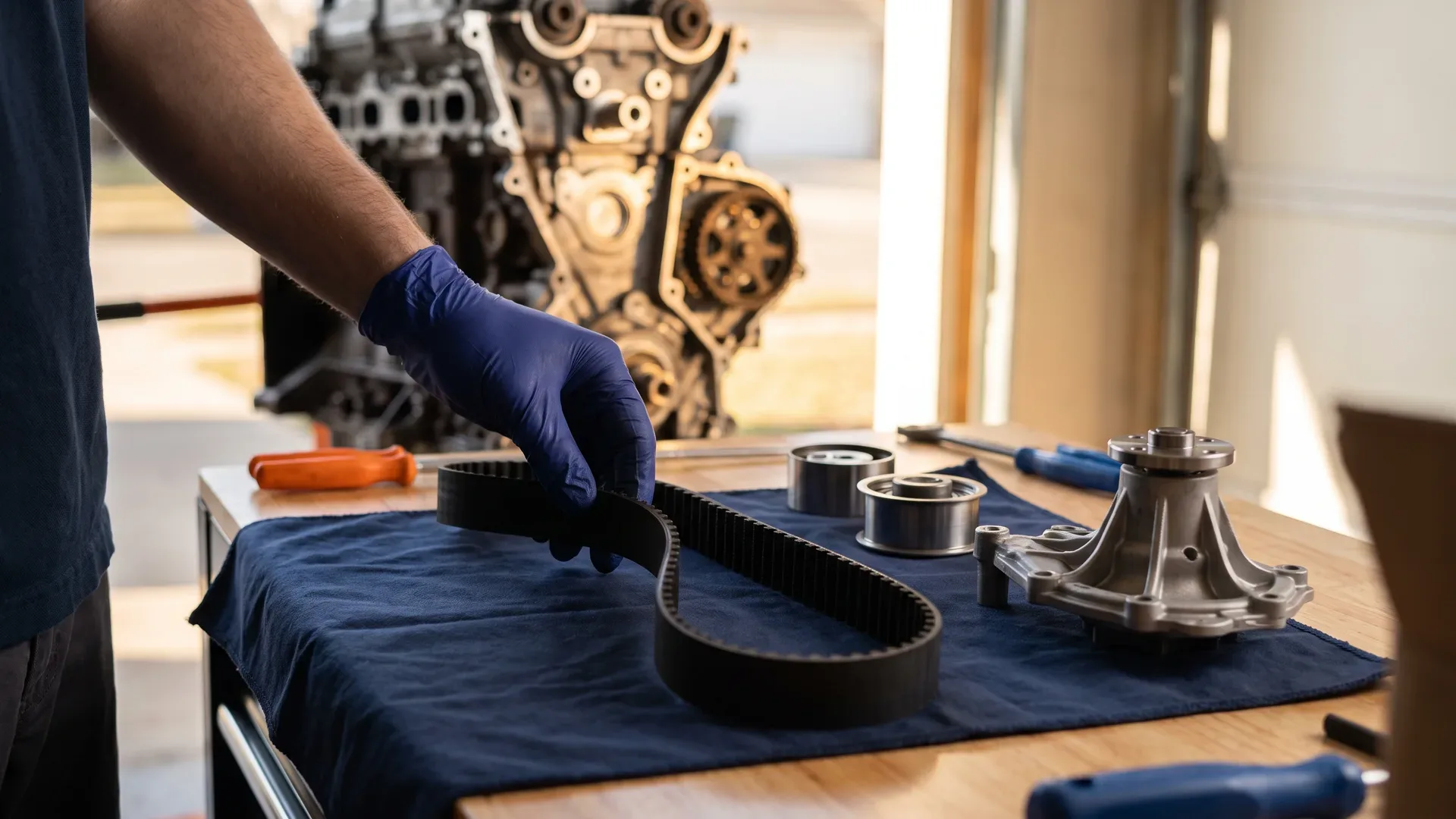
Change the timing belt at the mileage or age set by your engine's manufacturer, as soon as the first of the two limits is reached. Depending on the engine, intervals generally range from 60,000 to 240,000 km and from 5 to 10 years: only your car's service schedule gives the right figure.
Once the belt has been changed, keep the invoice safe. It is one of the first documents a buyer asks for. WheelTrust, the digital service record, files it with its date and mileage, shows the next due date, and includes it in the report you will show on the day you sell.
Why this is the due date not to miss
The timing belt, also called the cambelt, synchronises the rotating parts inside the engine: the crankshaft on one side, the camshafts on the other. It is hidden under a cover. You cannot see it, and you cannot hear it ageing.
When it snaps, the engine stops dead, and on many engines the valves and pistons collide. The bill then changes scale. In France, the major servicing chains put a timing belt replacement at between €250 and €800 in most cases, sometimes up to €1,000 on certain engines. A failure is more like €2,000 to €7,000, when the engine has to be replaced.
Changing the belt on time therefore costs a fraction of the price of a failure.
When to change the timing belt: mileage or age
The service schedule almost always gives two figures, for example "120,000 km or 6 years". You do not pick the one that suits you. You change the belt as soon as either one is reached.
Age matters because rubber ages even when the car is not being driven. A small city car covering 8,000 km a year would take 15 years to reach 120,000 km. With a "120,000 km or 6 years" schedule, it is the sixth year that triggers the replacement, not the odometer.
The right interval is in the manufacturer's service book or service schedule, often kept in the glovebox or available in the owner area of the brand's website. Failing that, your mechanic can find it from the vehicle identification number (box E of the French registration certificate). You then need a starting point: the invoice for the last replacement, if you have it.
Be wary of "average" figures picked up on forums. Two versions of the same model can have very different intervals depending on the engine.
Signs of wear, and why you should not wait for them
Some signs can raise the alarm, such as a regular ticking from the engine or unusual vibrations. A professional who removes the cover may also see cracks or damaged teeth on the belt.
Unfortunately, in most cases the belt snaps without warning. Waiting for a symptom means waiting for the breakdown. The only reliable method remains the manufacturer's schedule.
What a replacement includes
People often talk about a "timing belt kit". It includes the belt, the idler pulleys and the tensioner. On many engines, the water pump is driven by the same belt. Servicing chains then recommend replacing it at the same time, since access is already open.
A common trap on invoices: the auxiliary belt is not the timing belt. The first drives the alternator or the air conditioning, it is visible and costs little. An attentive buyer will tell the difference. Check that your invoice clearly says "timing belt" or "timing belt kit", and keep it as it is.
Timing belt or timing chain?
Many recent engines use a chain rather than a belt. A metal chain generally has no fixed-date replacement in the service schedule. It still needs attention: a metallic noise on a cold start justifies a trip to the garage.
To find out what your engine hides, look at the service schedule. If it includes a line "timing belt replacement", you have a belt. If in doubt, your mechanic will tell you in a minute.
Belts that run in oil
Some recent petrol engines use a so-called "wet" belt, which runs in the engine oil. For these engines, the manufacturer sets its own intervals and, sometimes, interim checks of the belt. Here again, the service schedule is what counts.
A concrete example shows how much proof of maintenance can weigh. In France, for certain PureTech petrol engines, the manufacturer has set up special cover in case of premature belt wear or excessive oil consumption. It runs up to 10 years or 180,000 km, whichever comes first, from the start of the original warranty, depending on the vehicle's production date. It is granted on condition that the service schedule has been followed.
In this kind of situation, every oil change counts as much as the belt itself. Without invoices, the vehicle has to be inspected, and proving the maintenance becomes more complicated. We cover this link between maintenance and warranty in our article on the manufacturer warranty (in French).
Why the invoice is worth its weight in gold when you sell
On a car approaching or past 100,000 km, the timing belt is one of the buyer's first questions. They know the part is invisible. They also know what a failure costs.
Without an invoice, the buyer assumes the replacement is still to be done, and takes its cost off the price. With a dated invoice, showing the mileage and a garage's name, the same expense becomes an argument. You paid for the timing belt: it may as well show in the selling price. We explain this mechanism in service record and resale value (in French) and in our article on depreciation (in French).
Timing matters too. Selling just before the due date means handing the replacement to the buyer in the form of a discount. Selling just after, invoice in hand, changes the conversation.
With WheelTrust: the due date, the proof, the handover
Here is how the tracking works, from the garage invoice to the buyer.
Photograph the timing belt invoice. AI invoice reading fills in the date, mileage, professional and amount for you. The invoice stays attached to the service entry.
Log the next due date, as a date or a mileage, according to your service schedule. Preferably enter the age-based deadline: that is what makes the due date appear under your Upcoming due dates, with a "Coming up" badge three months ahead. A due date entered in kilometres stays listed under your Upcoming due dates ("at 220,000 km", for example), without an urgency badge, since the app does not guess how much you drive.
On the day you sell, generate the vehicle's PDF report or send a share link. The timing belt appears with its date, mileage and supporting document, in the middle of the full history.
Once the sale is agreed, transfer the record to the buyer. They get the history and the invoices, and will know in turn when to plan the next timing belt.
The online service record, invoice reading, the report and the transfer are included in the free plan. Details are on the pricing page.
Schedule your next timing belt today. Create my record for free, then photograph your last timing belt invoice. WheelTrust is a web app: it opens on your phone, with nothing to install. You can also see what the record looks like.
Frequently asked questions
How many kilometres between timing belt changes?
It depends on the engine. Intervals generally range from 60,000 to 240,000 km, with an age limit of 5 to 10 years. The exact figure is in the manufacturer's service schedule, and the first limit reached is the one that counts.
Should you change the belt if the car is hardly driven?
Yes, at the age set by the manufacturer. Rubber ages even when the car is parked. A car that covers few kilometres almost always reaches the age limit well before the mileage limit.
How much does a timing belt change cost?
In France, most often between €250 and €800, sometimes up to €1,000 depending on the engine and access. The price also depends on what the kit includes, with or without the water pump. A failure costs far more: several thousand euros if the engine is damaged.
Does my car have a timing belt or a timing chain?
The service schedule tells you. If it provides for replacing the timing belt, your engine has one. If not, it is probably a chain, which generally has no fixed due date. Your mechanic can confirm it from the vehicle identification number (box E of the French registration certificate).
I have lost the timing belt invoice. What can I do?
Ask the garage that did the work for a duplicate: it usually keeps a copy. Then add it to your record. Our article on the lost service book (in French) explains how to rebuild a history document by document.
Sources
Sources in French.
Sud Radio, "On parle auto" programme, "Prix courroie de distribution : le vrai coût en 2026" (Timing belt prices: the real cost in 2026), 28 September 2026: price ranges and intervals quoted by servicing chains, cost of a failure, symptoms, belts often failing without warning, water pump. https://www.sudradio.fr/on-parle-auto/prix-courroie-de-distribution
Peugeot France, "Moteurs PureTech, nos solutions" (PureTech engines, our solutions): special cover up to 10 years or 180,000 km, reserved for vehicles serviced according to the manufacturer's recommendations; replacement intervals referred to the vehicle's service book. https://www.peugeot.fr/entretien-et-services/moteurs-puretech-solutions.html
Your vehicle manufacturer's service schedule (service book or the brand's owner area): the only reference for the exact interval.
The WheelTrust team