

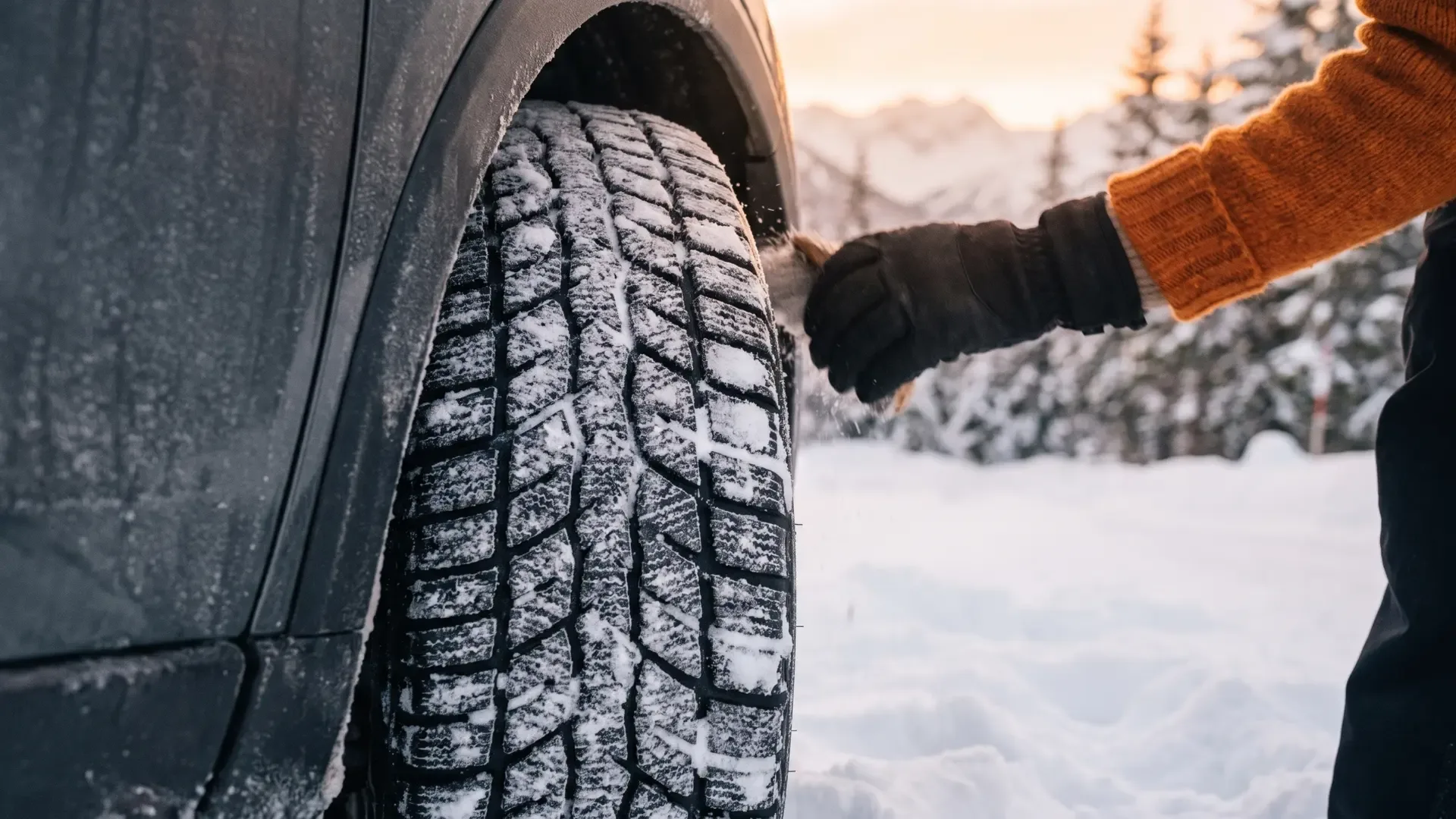
In France, from 1 November to 31 March, in the mountain municipalities designated by the prefect, your car must run on four winter tyres marked with the alpine symbol (3PMSF), or carry snow chains or snow socks. The requirement covers 34 French departments, but the €135 fine that is often quoted still does not apply: the decree meant to create it has not been published.
That leaves the practical question, the one that comes back every autumn: when should the tyres go on, and what state were they in when you stored them in April? WheelTrust, the online service record, keeps those answers for you. You log the fitting with its invoice, you schedule the removal, and on the day you sell, the buyer sees that the car was properly shod every winter.
What the Mountain Law says, in plain terms
The rule comes from France's Mountain Law (loi Montagne) of 28 December 2016. Decree no. 2020-1264 of 16 October 2020 spelled it out, and it has applied since the 2021-2022 winter. It is written into the French Highway Code (code de la route), at Article D. 314-8.
During the winter period, which runs from 1 November to 31 March of the following year, certain mountain municipalities require equipment suited to snow. The dates do not move with the weather. On 2 November, in bright sunshine, the requirement already applies.
It is not the whole of France, nor even a whole department. In each of the 34 departments concerned, the prefect, the State's representative in the department, sets the list of municipalities by order. They lie in the mountain ranges: the Alps, the Massif Central, the Jura, the Pyrenees, the Vosges and Corsica.
How to tell whether you are entering a zone
Two road signs were created for this in 2021. Sign B58 marks the entrance to a zone where winter equipment is mandatory. Sign B59, crossed out, marks the exit. They are rectangular and white, with tyre and chain pictograms.
Before setting off for a ski trip or to visit family at altitude, the simplest move is to check the order for your destination department, on its prefecture's website. Sécurité routière, the French road safety agency, also publishes a map of the departments concerned (link at the end of the article).
Accepted equipment
For a private car or a light van, you have two options.
Winter tyres on all four wheels. The text requires "winter" tyres on at least two wheels of each axle, which amounts to four tyres on a car. All-season tyres count too, provided they carry the right marking.
Snow chains or snow socks in the boot. It is enough to have them on board, in working order, to equip at least two driving wheels. You only fit them when there is snow. Metal chains suit frequent use, textile snow socks occasional use. Check that they match your wheel size: chains bought for another car are of no use to you.
Vehicles fitted with studded tyres are exempt.
The end of M+S-only tyres
This is the change many people missed. Until 31 October 2024, a tyre marked only M+S ("mud and snow") was accepted. Since 1 November 2024, the tyre must carry the alpine symbol: a three-peaked mountain with a snowflake, known as 3PMSF. This marking rests on a standardised snow grip test (UN Regulation No. 117), which is not the case for M+S.
If your tyres only carry M+S, they remain legal to drive on. But in a mountain zone, they no longer exempt you from having chains or snow socks on board.
The marking is on the tyre sidewall. While you are there, read the DOT code too: its last four digits give the week and year of manufacture. A winter compound that has hardened over the years loses part of its benefit, even if the tread looks fine.
Motorcycles are not affected
Article D. 314-8 only covers cars, vans, motorhomes, coaches and heavy goods vehicles. Two-wheelers, three-wheelers and motorised quadricycles are not on the list. For heavy goods vehicles with a trailer, the rule is stricter: chains must be on board, even with winter tyres.
The €135 fine: what is true in October 2026
Many articles announce a €135 fine and possible immobilisation of the vehicle. That was the plan. It is not what applies.
A penalty of this kind has to be created by decree, and that decree has never been published. The French Ministry of the Interior put it in black and white, replying to a senator from Haute-Savoie, in the Senate's Official Journal of 12 February 2026: "From the outset, the measure has been applied in an educational way, without penalties" (our translation). The same reply states that the decree "could not be published in 2025", without giving a new date.
With the 2026-2027 winter approaching, no penalty decree has been published in the Official Journal. If that changes before or during the season, we will update this article.
In practical terms, having no fine does not protect you from snow. A pass closed to unequipped vehicles stays closed, and a car on summer tyres on an icy road remains dangerous. Equip yourself for the road, not for the police check.
Fitting and removing at the right time, without thinking about it
The real problem with winter tyres is not the law. It is the calendar. You have to book at the end of October, when every garage is full, then remember to switch back to summer tyres in spring. Winter tyres are made for the cold: keeping them on all summer wears them out for no benefit.
In WheelTrust, you add an upcoming action to your car's vehicle record: "Fit the winter tyres", with a date in October. Then a second one: "Switch back to summer tyres", in early April. They appear under Upcoming due dates in your Garage, next to the roadworthiness test, and switch to "Overdue" if the date passes. You can attach the garage's quote or a photo of the stored tyres.
If you have several vehicles, each one has its own record and its own due dates. The free plan tracks one vehicle; to track several, see the pricing page. The car that goes up to the ski slopes does not necessarily follow the same calendar as the one that stays in town.
The tyre invoice, read for you
On fitting day, photograph the invoice. WheelTrust reads it with AI and fills in the date, mileage, garage and amount for you. You check, you save, and the invoice stays attached to the service entry it proves.
Add a photo of the sidewall to the service entry, or to the upcoming action for the removal, with the 3PMSF symbol and the DOT code clearly legible. The day you wonder whether your winter tyres have another season left in them, the answer is in the record, not in a glovebox. What each plan covers is set out on the pricing page.
To know which other invoices are worth keeping, the article maintenance invoices: which ones to keep (in French) sorts them out.
When you sell, proof rather than a promise
"It always had winter tyres" is easy to say. A careful buyer has no way of checking it.
With WheelTrust, they can see it. Every fitting and every removal appears in the history, dated, with the mileage and the invoice. You can send them a share link while the ad is running, or hand them the record's PDF report. Once the sale is agreed, you transfer the full record to them: they receive it with the service entries and their supporting documents, on a free account.
For a car that has spent its winters in the mountains, this history matters. It shows the car was looked after for the roads it was driven on. The article service record and resale value (in French) explains what this changes in the negotiation.
Before 1 November, log the fitting date of your winter tyres and schedule the removal right away: create your car's record. It is free, with no bank card, and WheelTrust opens straight in your phone's browser, with nothing to install. You can also see how the record works before you start.
Frequently asked questions
Does the Mountain Law accept all-season tyres?
Yes, if they carry the 3PMSF alpine symbol on the sidewall. Since 1 November 2024, an all-season tyre marked only M+S is no longer enough: you then need chains or snow socks in the vehicle.
Are winter tyres mandatory everywhere in France?
No. The requirement only applies in the mountain municipalities listed by prefectoral order, in 34 departments, and only from 1 November to 31 March. Elsewhere, winter tyres remain a choice. Signs B58 and B59 mark the entrance to and exit from the zones concerned.
Could I get a €135 fine this winter?
Not at present. The decree meant to create the penalty has not been published, and the French Ministry of the Interior confirmed in February 2026 that the measure is applied "in an educational way, without penalties". The equipment requirement itself does exist.
Does my motorcycle need winter tyres?
No. Motorised two-wheelers are not among the vehicles covered by Article D. 314-8 of the French Highway Code. If your motorcycle stays in the garage for the winter, the article on motorcycle maintenance (in French) runs through the useful checks.
Should I keep the winter tyre invoice?
No law requires it. It still serves you twice: to follow the age and wear of your tyres from one season to the next, and to prove the maintenance to a buyer. In a WheelTrust record, it stays attached to the fitting it proves.
Sources
Sources in French.
Decree no. 2020-1264 of 16 October 2020 on the obligation for certain vehicles to carry winter equipment, French Official Journal (JORF) of 18 October 2020: Légifrance. Article 1 (Article D. 314-8 of the French Highway Code, period from 1 November to 31 March, vehicle categories); Article 2, in force since 1 November 2024 (alpine symbol required).
Order of 23 June 2021 amending road signage (signs B58 and B59): Légifrance.
Service-public.fr, the French government's information site, "Pneus hiver, chaînes : quelles sont vos obligations jusqu'au 31 mars 2026 ?" (Winter tyres, chains: what are your obligations until 31 March 2026?), 29 October 2025: service-public.gouv.fr (34 departments, accepted equipment, studded tyres, heavy goods vehicles with a trailer).
French Ministry for the Ecological Transition, "En hiver : les bons réflexes avant de prendre la route" (In winter: good habits before setting off), 20 November 2025: ecologie.gouv.fr.
French Senate, written question no. 06613 from Ms Sylviane Noël, reply from the Ministry of the Interior published in the Senate Official Journal of 12 February 2026, page 816: senat.fr.
Sécurité routière, "Nouveaux équipements hivernaux" (New winter equipment, map of the departments): securite-routiere.gouv.fr.
Sécurité routière, "Équipements hivernaux : départements et communes" (Winter equipment: departments and municipalities, list of municipalities): securite-routiere.gouv.fr.
The WheelTrust team