

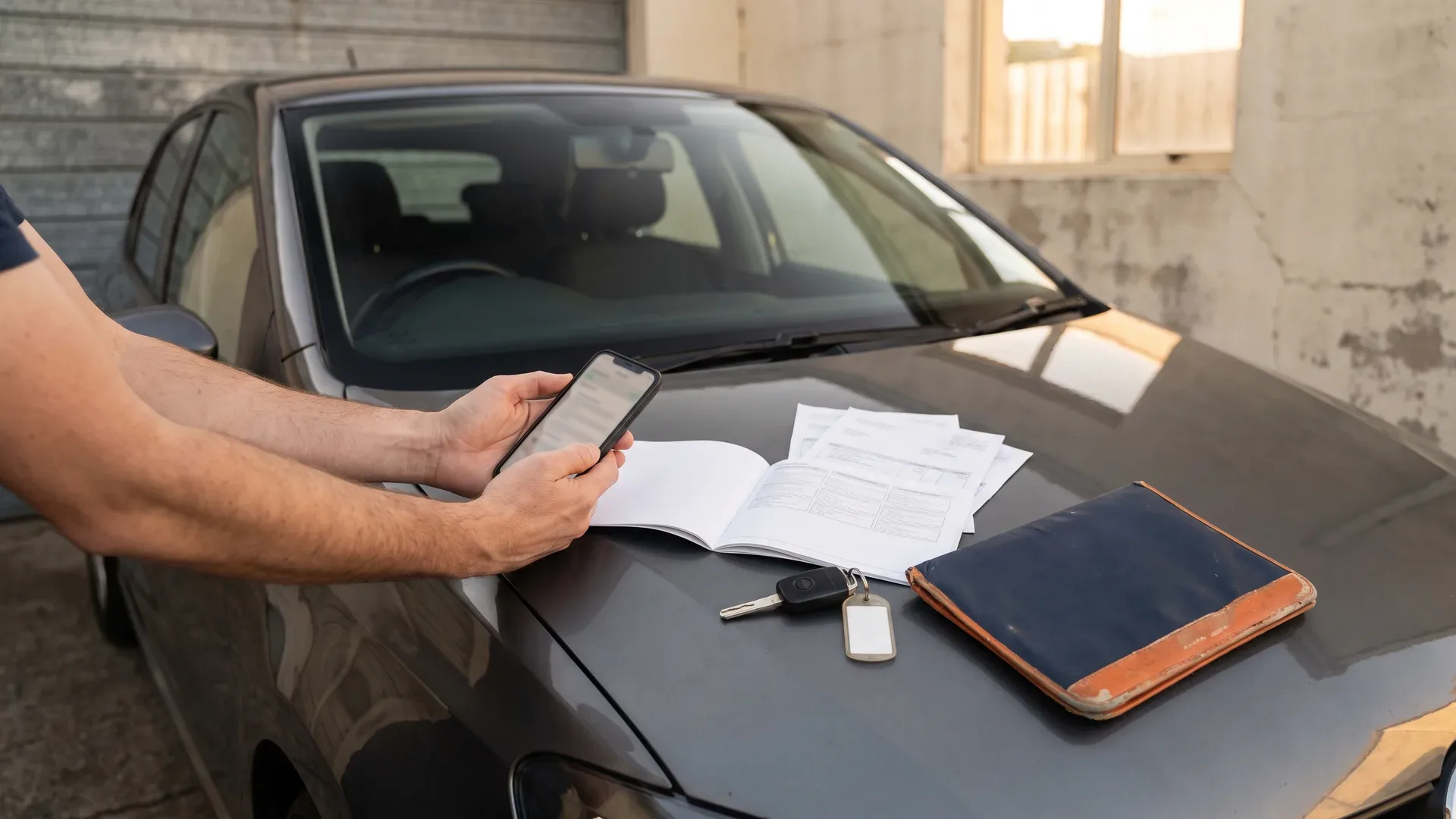
You find an advert, the car looks right, and two questions turn up together: where has it been, and how was it looked after? The first has a paid answer in minutes: a history report is bought online with a VIN and a card payment. The second needs the service history. That cannot be bought: you ask the seller for it. With WheelTrust, the service history can even change hands on the day of the sale, free of charge, with its invoices. The two documents do not describe the same car, and a buyer needs both answers.
The short answer
A paid history report reads databases that sit outside the car: recorded accident damage, mileage readings logged over time, previous keepers, import status, stolen vehicle records. The service history kept by the seller holds what those databases almost never record: dated jobs, the mileage at each one, the parts fitted, the garage that did the work, and the invoices behind it. The report tells you where the car came from. The service history tells you how it was treated. And if it is handed over to the buyer, as WheelTrust allows, it keeps telling that story after the sale.
What a paid history report actually contains
History reports sold online are bought by the buyer directly, without going through the seller. They pull from national registers and from data held by insurers, auction houses and franchised workshops. Expect to pay a few tens of euros per report, a little less if you buy several at once (recorded on 17/09/2026).
What you get, where the data exists for that country: the mileage record and any sign the odometer has been wound back, logged damage, a stolen vehicle check, previous use as a taxi or hire car, changes of keeper and import details.
There are cases where the report is worth every penny, and it is only fair to say so. A car imported from abroad whose foreign past is unreadable from here. A mileage figure that does not match the wear on the seat bolster and the pedals. A claim settled, repaired, and never mentioned during the viewing. A vehicle still flagged as stolen. No service history, however carefully kept, catches any of those four. The report does.
Part of those checks is free, and it too comes from the seller: the HistoVec report. HistoVec is a French public service run by the Ministry of the Interior for cars registered in France, and its data comes from the national vehicle registration system (SIV). Only the holder of the registration certificate can generate it, then they send it to you as a link or a PDF. It shows the date of first registration, changes of owner, damage repaired under the official supervised-repair procedure, the administrative status (outstanding finance, a block on transfer, reported theft) and the mileage recorded at each roadworthiness test. HistoVec gives you the official paperwork, free; a paid report adds other databases on top, and the handed-over service history carries the upkeep those registers almost never record.
What it leaves out
Read the small print of the report sellers themselves: "if available", "may include". Service details appear among the things a report may contain, never among the things it guarantees. The real contents depend on which databases are reachable in the country of registration.
A report knows nothing about work that never reached a database. The independent garage two streets from the seller reports to nobody. The cambelt done at 118,000 km, the clutch, last spring's four tyres, what was paid and the invoice proving it: all of that lives in a folder or in an app, not in a national register.
A report is also a snapshot. It describes the car up to the day you buy it, then it stops. You keep the document, but nobody adds to it after you.
What a handed-over service history carries
In WheelTrust, every job is recorded with its date, its mileage, the garage and the cost, and the invoice stays attached to the entry it proves. The seller did not have to retype everything: they photographed their workshop invoices, AI invoice reading filled in the date, the mileage, the garage and the amount, and they checked it before confirming.
The real difference is that this service history changes hands. The seller enters the buyer's email address on the vehicle's page. The buyer receives a link valid for 48 hours, opens a free account with that address and accepts. The service history then becomes theirs: the service entries, the supporting documents and the vehicle's details. The seller loses access. Their personal papers, registration certificate, driving licence or original purchase invoice, stay in their account.
Before the sale, the seller can also show the service history without handing it over. A share link opens the vehicle report and nothing else from their account, and the same report exists as a PDF. The service history itself is described on the online service history page.
This document has a limit, and it is worth naming: it holds what the owner put into it, nothing else. A seller who skipped a service will not invent one. It is a declared record backed by invoices, not an official register. A service history offered without being asked already says something. One full of gaps says something else. Either way, the buyer sees it.
Both together, and the verdict
A paid report makes sense if the car came from abroad, if the mileage does not match the wear, if the seller goes vague about accident damage, or if the money at stake is worth a check. A handed-over service history answers a different question: how the car was maintained, by whom, with which parts. And it keeps answering after the purchase. For a recent, expensive used car, or for one you plan to keep for years and then sell properly, get both.
The order is straightforward. Ask for the service history first: it costs nothing, and the seller's answer already tells you something. Buy the report afterwards, if your doubt is about the car's past rather than its upkeep.
Are you the one selling? The step that reassures the buyer takes a minute. You open the vehicle's page in WheelTrust, enter their email address, and the service history leaves with the car as soon as they accept. The transfer is included in the free plan. The step-by-step guide, with what goes and what stays with you, is on the transfer your service history to the buyer page. The seller's side of the story is in the article handing the service history to the buyer.
Frequently asked questions
If the seller provides a service history, do I still need a paid report?
It depends on what is worrying you. A service history answers questions about upkeep, not about accident damage, theft records or imports. On a car bought new by its seller and serviced at the same garage throughout, it covers most of the doubt. On an import, the report still earns its place. If the car is registered in France, also ask the seller for their HistoVec report: it is free and already covers outstanding finance, transfer blocks and reported theft.
Does receiving the service history cost the buyer anything?
No, but an account is needed. The transfer arrives at an email address, and the buyer opens a free WheelTrust account with that address to accept it, with no card details. They receive the whole history that was handed over, invoices included. If their account has already reached the number of vehicles on their plan, the service history still arrives, complete: it stays readable and transferable, but not editable, for as long as it stays within the free plan. What each plan covers is set out on the pricing page.
How much is a service history worth if the seller typed it in themselves?
It is worth what its attachments are worth. A dated entry with the mileage, the garage name and the invoice attached can be checked in seconds. With nothing attached, it is a claim. Look at how many entries have their invoice attached.
Does the seller keep a copy after the transfer?
No. The moment the buyer accepts, the seller's access ends. That is what separates a transfer from a shared link: the car and its history change hands together. To keep a record, the seller prints the report as a PDF before starting the transfer.
Sources
History reports sold online: order of magnitude of prices and the "if available" wording for service data, recorded on 17/09/2026 on the pricing pages and public descriptions of the two best-known offers in France.
HistoVec, a free French public service run by the Ministry of the Interior: report generated only by the holder of the registration certificate, sent as a link or a PDF, showing first registration, changes of owner, damage repaired under the supervised-repair procedure, administrative status and roadworthiness test mileage. histovec.interieur.gouv.fr and the "Vendre ou donner son véhicule" page on service-public.gouv.fr, consulted on 19/10/2026.
WheelTrust service history transfer: link valid for 48 hours, free account on the buyer's side, seller loses access on acceptance, account documents not transferred. Transfer your service history to the buyer page, consulted on 18/10/2026.
Features included in WheelTrust's free plan (AI invoice reading, PDF report, service history transfer): pricing page, consulted on 18/10/2026.
The WheelTrust team